
Digital signage & alerts
Every screen in the building — one panel, seconds to reach them all
Run playlists on the televisions you already own from one panel, then interrupt every screen in seconds when something matters — self-hosted, with no per-screen fees.
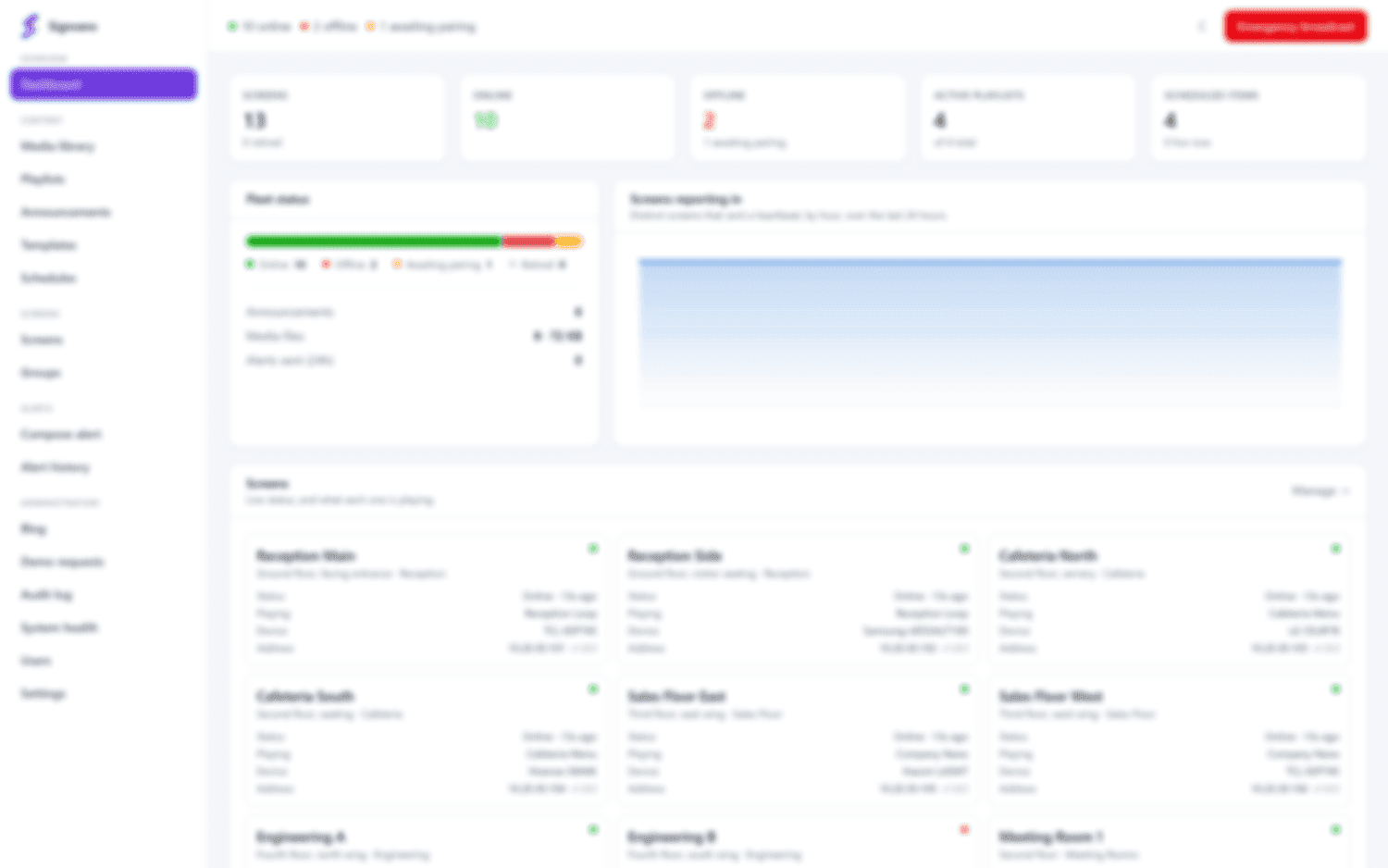
Signvero is a self-hosted platform that turns the televisions you already own into a controllable signage estate. Run playlists on every screen from a single panel, then — the moment something matters — take over all of them in 2 to 5 seconds, over whatever is playing. It runs on your own server, so nothing leaves the building, and it is built for any organisation with more screens than it can reach.
Why most signage fails when it matters
Most buildings already have the screens, but no way to reach them at once. Changing what is on them means walking to each display with a USB stick, and when something actually matters — a fire drill, an evacuation, a visitor at the gate — there is no way to put it on all of them. A wall that has quietly stopped working looks exactly like one that is working. Signvero replaces that with one control panel: every screen visible, every screen reachable, and an emergency channel that interrupts everything else in seconds.
What it does
A signage player and an alert channel that behave the way a building actually needs.
Emergency alerts
Compose an alert with a layout, priority, duration and targets, and it interrupts every screen — even a TV showing another app — within 2–5 seconds, with a delivery report per screen afterwards.
Fleet overview
See fleet status, uptime and what every screen is playing from one dashboard, so a screen that has quietly stopped working no longer looks fine.
Playlists & media
Build loops of images, video and designed announcement cards with per-item timing; media is checksummed and deduplicated in the library.
Scheduling
Assign content to individual screens, groups or all displays; overlapping schedules resolve deterministically, so what appears is a decision, not a coincidence.
Offline playback
Every screen keeps playing from its own local storage when the network goes down; missed content and alerts are re-sent once it reconnects.
Announcement cards
Eight built-in layouts render as cards drawn directly on the player, staying sharp at any size — no external design tool needed.
Runs on screens you own
Android TV devices work directly, browser displays use the web player, and older sets take an inexpensive Android box over HDMI.
Users, roles & audit
Five permission-gated roles from super administrator to read-only, plus an audit log recording who did what, to which screen, and when.
Screens
A closer look inside Signvero
Real screenshots of the running system — the panel and the player. Tap any shot to enlarge it.
Industries we serve
One system, many kinds of building
Signvero is sold by the kind of building it goes into rather than a shop type — anywhere that runs screens on the walls and needs to interrupt them.
Offices
Reception loops, meeting-room boards and company news, plus a fire-drill alert that reaches all of them at once.
Factories & warehouses
Shift boards, line status and safety messaging on screens that keep working when the network does not.
Healthcare
Waiting-room information and department wayfinding, with an alerting layer that takes precedence when it has to.
Retail & hospitality
Menus, offers and opening hours on a schedule, across every site you run, changed from one desk.
Education
Notices, timetables and events across faculties and buildings, and a lockdown channel that reaches all of them.
Public sector
Signage on your own infrastructure, with a full record of everything — for organisations where where the data lives is the first question.
Anywhere with screens on the walls and a reason to interrupt them — offices, factories, hospitals, campuses, shops or public buildings — the same self-hosted system fits, with content and alerts scoped to each area. Tell us what your building shows and we will show you how it maps.
Talk to usWhat it is measured at
- An emergency alert is on every screen in 2–5 seconds on shared hosting — under a second on a socket-capable server.
- Playback continues at 100% during a network outage; screens catch up on their own when it returns.
- One modest shared-hosting server runs 25+ screens on SQLite, and far more on MySQL.
- Screens deploy in about two minutes each — one small Android APK and a six-character pairing code.
- There are no per-screen licence fees: one licence covers unlimited screens and users.
Common questions
On your own server — shared hosting, a VPS, or a machine in your office. It needs PHP and a database, nothing more exotic.
Two to five seconds on shared hosting with no WebSocket, measured rather than estimated. On a server that can run a socket it is under a second.
Every screen keeps playing from its own storage. Alerts sent during the outage are delivered when the screen comes back, and the server re-sends any content it missed.
No. Android TV devices work directly, browser-compatible displays use the web player, and older sets can use an inexpensive Android box over HDMI.
Twenty-five comfortably on shared hosting with SQLite. Moving to MySQL is four lines of configuration and takes it far beyond that.
No. It is priced once, not per screen — one software licence for hardware you own, with unlimited screens and users.
See it take over a screen
Book a walkthrough and we will show the alert channel, the offline playback and the per-screen delivery report on real screens — arranged on request rather than a public login.