
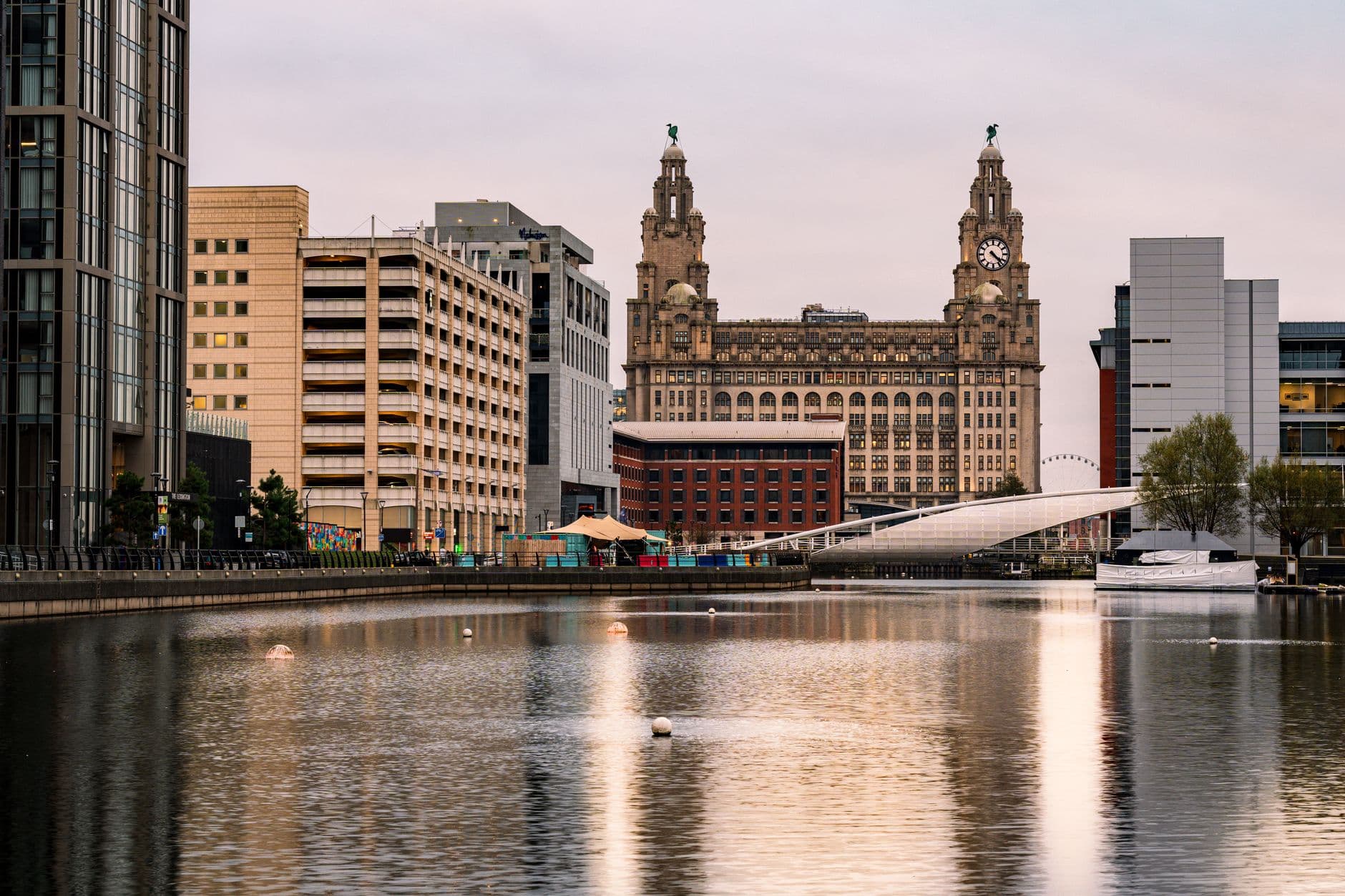
Liverpool · Merseyside
Software, web, mobile & digital marketing for Liverpool Businesses
We have no office in Liverpool. Fugen Services is registered in Glasgow, at 3/2, 4 Buccleuch Street, G3 6SL, and Merseyside clients are served remotely with travel across for meetings that justify the trip. The west coast line helps: Glasgow Central to Lime Street is a direct run of roughly three and a half hours, and the M74 and M6 take about the same, so a day return is realistic rather than theoretical. We build web platforms, custom software, mobile and cross-platform apps, eCommerce, APIs, AI tools and point-of-sale systems for firms across the city, from Baltic Triangle studios to port and logistics operators and Knowledge Quarter research spin-outs.
Background photo by Michał Robak on Pexels
Working with Liverpool businesses
Liverpool's economy has been rebuilt around a handful of very specific assets. The port remains the largest of them, with the Liverpool2 deep-water container terminal at Seaforth, Peel's long-running Liverpool Waters development along the northern docks, and freeport status pulling port-centric manufacturing and distribution into the city region. The Knowledge Quarter and Paddington Village carry the research economy, anchored by the University of Liverpool, the Liverpool School of Tropical Medicine and the Royal College of Physicians at the Spine, with the region's life sciences investment zone behind it. The Baltic Triangle, converted from warehouses by Baltic Creative and now home to Digital House and the Baltic Ventures accelerator, is where the digital and creative firms sit. The traditional commercial district around Old Hall Street, Castle Street and India Buildings holds professional services. Beyond the city boundary, advanced manufacturing runs through Jaguar Land Rover at Halewood, AstraZeneca at Speke, Unilever at Port Sunlight and Pilkington at St Helens. Liverpool ONE, the waterfront and the arena carry a large visitor economy.
Why Liverpool businesses work with us
Liverpool is well supplied with digital agencies, particularly around the Baltic Triangle, so the case for a Glasgow firm has to be specific. It usually comes down to capacity, cost or a skill you cannot easily buy locally: heavier integration work across port, manufacturing and finance systems, AI work that needs a feasibility check before anyone commits budget, or a dedicated development team you can scale without recruiting. Practically, the west coast line makes a day return workable, so we can be in your office when it matters rather than only on video. We work under the same UK GDPR rules, the same Companies House register and the same currency, and we are open that Liverpool is served from Glasgow rather than from a desk on Old Hall Street. If what you actually need is someone half an hour away every week, hire locally.
How we work at this distance
The distance sets the rhythm. Discovery is a day on site in Liverpool, ending in a written scope that states what will be built, what will not, and the price against it. Delivery runs in two-week blocks with working software at the end of each, a weekly video call, and a single shared channel rather than email chains. We travel across for milestone reviews, user testing and handover, and agree travel costs in advance so they never arrive as a surprise. You hold repository access from the first commit and every hosting and third-party account is opened in your name, so nothing about the arrangement traps you with a supplier three and a half hours away.
The Liverpool market, honestly
Liverpool is a more affordable place to build software than Manchester, and considerably more affordable than London, which is a large part of the Baltic Triangle's appeal to firms that started elsewhere. The complication is retention: Manchester is around thirty-five minutes away by train and pays more, so experienced developers are within easy reach of a better offer, and mid-level people move earlier than employers expect. Graduate supply is strong from the University of Liverpool, Liverpool John Moores, Hope and Edge Hill, but the senior and contract market is thinner than the city's size suggests. For most Liverpool SMEs the sensible mix is a small permanent team for the work that never stops, with outside capacity for projects.
Popular Liverpool searches
A development company near you
Searched for a “software development company near me” around Liverpool? We work with Liverpool and nearby businesses as a dedicated remote team — Glasgow-registered, on UK hours, and on site for the meetings that need it.
Talk to us about LiverpoolWhat Liverpool industries actually need built
Not a list of services — the specific gap we most often find in each of these sectors here.
Maritime, port and logistics
Freight forwarders, hauliers and port-adjacent operators run on incompatible feeds: carrier APIs, EDI messages, customs documents and warehouse systems. The valuable build is integration plus one internal application that shows a consignment's real status, rather than another dashboard nobody trusts.
Life sciences and health research
Knowledge Quarter groups and life sciences companies accumulate study and instrument data across spreadsheets and legacy tools. A properly built web application captures it once, with role-based access, audit history and UK GDPR-compliant handling, and exports in the formats funders and collaborators actually require.
Digital, creative and games
Baltic Triangle studios and agencies often need the platform around their product: account systems, analytics pipelines, client review tools, subscription billing and content-managed sites. Frequently they have the creative and product skill in-house and need engineering capacity for a defined period.
Advanced manufacturing
Suppliers feeding the automotive, chemical and consumer goods plants across the city region need traceability, quality records, downtime and maintenance logging, and reporting in the formats their customers dictate. That is web application and integration work sitting beside existing plant systems, not a replacement for them.
Visitor economy, hospitality and events
Hotels, venues, tour operators and bars around the waterfront and city centre need booking, ticketing and capacity tools that survive match days and event weekends, plus tills that handle real volume. Our point-of-sale range covers the restaurant, cafe, fast food and retail side of that.
What we build for Liverpool clients
Every service below is available to Liverpool and Merseyside businesses.
Software Engineering
AI & Automation
Design & Experience
Growth & Marketing
Cloud & Infrastructure
Dedicated Teams
Liverpool questions
Including whether we actually have an office here — we do not, and we would rather say so.
No. Our only registered address is 3/2, 4 Buccleuch Street, Glasgow G3 6SL, and you can verify that on Companies House. Liverpool work is delivered remotely, with travel across for the sessions that need people in a room. We would rather be straight about it than advertise a co-working desk in the Baltic Triangle as though it were a local team.
Discovery is normally a full day on site, and we return for milestone reviews, user testing and handover. Glasgow Central to Lime Street is a direct train of roughly three and a half hours, so a day trip works without an overnight stay. Between visits, expect a weekly video call, a working build every fortnight and one shared channel for everything else.
Yes, at the integration and internal-tooling layer. Carrier and EDI feeds, haulier booking, container and consignment visibility, customs document handling, and dashboards that replace four systems and a spreadsheet. We are not replacing a terminal operating system, and any supplier who suggests they can do that on a fixed price should be treated carefully.
Yes. The usual need is capturing study, sample or instrument data in one place, with role-based access, defensible handling under UK GDPR, and exports collaborators will accept. We build to whatever governance and ethics approvals you already hold, and we do not make clinical claims or advise on regulatory pathways. That belongs with your own specialists.
Marketing websites are £4,500–£9,000 and content-managed websites £9,000–£25,000. Web applications start from £12,000, mobile apps from £15,000, and cross-platform apps run £22,000–£45,000. AI feasibility assessments are £3,000–£6,000, AI chatbots start from £6,000, and server management runs from £250 per month. Final figures follow discovery and a written scope.
Yes. The range covers cafe and restaurant, fast food, bakery, grocery, retail, fashion, repairs, computers and electronics, toys and gifts, wholesale and nursery. Being honest about the distance: configuration and staff training happen over video and remote setup, with an on-site visit if the site is complex. For a single-till independent, remote is usually enough.
It should be straightforward, and we build assuming it might happen. You hold the repository from the first commit, hosting and third-party accounts are in your name, and we write deployment and architecture documentation as we go rather than at the end. A Liverpool developer or an in-house hire should be able to take over without paying someone to reverse-engineer the work.
Also serving
Other UK cities
Building something in Liverpool?
Tell us the problem. We will tell you what would fix it, roughly what it costs, and whether we are the right people for it.
Get in touch