
Manufacturing ERP
The whole plant on one system
Quotation to payment on one system: production routing by machine and shift, quality on a defect library, real cost per piece, and books that tie without a month-end rebuild.
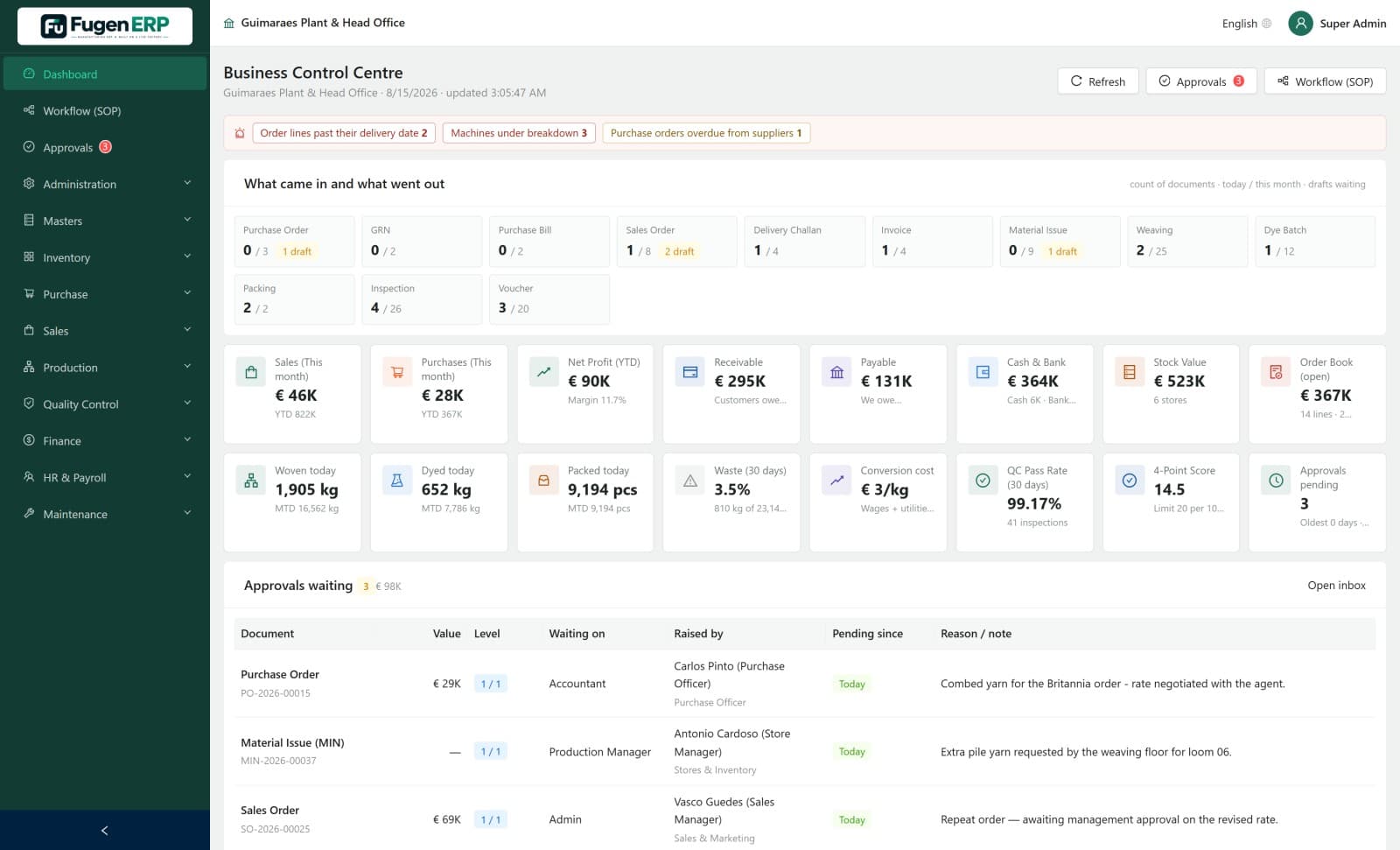
In most plants the store keeps a notebook, production keeps a register, sales keeps a spreadsheet, and accounts rebuilds the month afterwards — every number defensible on its own, and none of them agreeing. Fugen ERP runs the whole plant on one system: quotation → sales order → production → quality → packing → delivery → invoice → payment, with every step writing into one stock ledger and one set of double-entry books. It was built for a working terry-towel plant first — yarn store, ten looms, dyehouse, finishing, stitching, packing and finance — and the generic layer was extracted afterwards, so the shop floor is modelled properly rather than bolted on.
Where a plant loses the thread
Yarn and chemicals are issued without a recipe, so consumption is argued about at month end and nobody can say what a shade actually cost. Grey and finished stock live in separate books, so the balance is never trustworthy enough to plan against. Cost per piece is reconstructed after the order has shipped, so quoting is done on instinct and low-margin articles keep getting repeated. Purchase orders are released verbally and argued about when the supplier’s bill arrives. Quality is recorded on paper at the loom, so a recurring defect is only noticed after a buyer rejects a shipment. And the owner sees last month when they need to act on this week. Fugen ERP closes those gaps by making every operational document post straight into the stock ledger and the accounts.
What it does
The whole business on one system — the shop floor, the stores, the books and the controls.
Sales & order book
Quotation → sales order → delivery challan → invoice → receipt, with buyer-specific rates, packing instructions, shipment mode and LC references, and an order book that flags overdue lines.
Purchase & suppliers
Requisition → purchase order → GRN → incoming QC → supplier bill → payment, with lot numbers captured at the gate, rate history per supplier and payables ageing.
Inventory & stores
One stock ledger across yarn, chemical, dye, grey, WIP, finished goods and spares — batch and rack-wise, valued at moving cost, with no negative stock permitted.
Production routing
A production order per article, material issued against the recipe, then weaving, dyeing, finishing, stitching and packing entries by machine, shift and operator — with waste recorded at each stage.
Quality control
Incoming, in-process and final inspections against a defect library, 4-point scoring, pass/rework/reject routing that moves stock, and defect analysis by machine, shift, operator and article.
Product costing
Material cost from actual issues and conversion cost per kilo from wages, utilities and factory expenses, giving cost per piece against the sale rate — order by order, while it is still running.
Finance & accounts
Double-entry postings generated by the module that owns the event: trial balance, P&L, balance sheet, party ledgers and ageing at any time, in any currency with a base-currency view.
HR & payroll
Shift-wise attendance with overtime, leave and advances, paying monthly staff, daily-wage operators and piece-rate workers in one run that posts to the ledger by department.
Dynamic approvals
A control layer configured by the administrator: which documents need approval, at how many levels, by which role and above which amount — with a creator never able to approve their own document.
Business control centre & audit
One role-scoped screen for sales, profit, cash, stock value, plant output, quality and every pending approval — over an activity log that stamps who created, posted and approved each document.
Screens
A closer look inside Fugen ERP
Real screenshots of the running system — the reference towel plant, with four months of live documents. Tap any shot to enlarge it.
Industries we serve
One engine, many kinds of plant
Fugen ERP was built for textile and towel manufacturing first, but the engine — documents, one stock ledger, double-entry accounting, approvals, roles and reporting — is industry-agnostic. The modules, forms, printed documents and approval chains are reshaped per plant.
Textile & towel
The primary fit: weaving, dyeing, finishing, stitching and packing, end to end.
Apparel & garments
Cut-to-pack production, costing and stock for garment manufacturers.
Food & beverage
Batch production, recipes and quality with full traceability.
Pharma & nutraceutical
Controlled batches, QC and audit trails for regulated production.
Auto parts & engineering
Work orders, materials and costing for engineering shops.
Chemicals & coatings
Formulation, batch issue and stock valuation for chemical plants.
Furniture & wood
Job-based production, materials and costing for furniture makers.
Distribution & trading
Purchasing, stock and accounts for distributors and traders.
Packaging & printing
Job orders, materials and costing for packaging and print.
Building materials
Production, stores and accounts for building-materials manufacturers.
Ten industries are already mapped, and the engine adapts to whatever you make — the modules, printed documents, approval chains and reports are reshaped per plant while the stock ledger and books stay the same. Tell us what you manufacture and we will show you how it maps.
Talk to usWhat changes once it is in
- The trial balance ties without a month-end reconstruction — every posting comes from an operational document.
- No negative stock is possible in any store; the reference plant runs four months of documents with zero negative balances.
- Cost per piece and conversion cost per kilo are available while an order is still running, not after it ships.
- One payroll run covers monthly staff, daily-wage operators and piece-rate workers.
- Every document is attributable — who created, posted and approved it, at which level and after how long.
Common questions
It was built for a working terry-towel plant first — yarn store, ten looms, dyehouse, finishing, stitching, packing and finance — and the generic layer was extracted afterwards. The demo carries that plant’s four months of real documents.
Yes. The engine — documents, stock ledger, double-entry accounting, approvals, roles and reporting — is industry-agnostic; the modules, forms, printed documents, approval chains and reports are reshaped per customer. Ten industries are already mapped.
Any language, including right-to-left scripts. The interface is fully translatable, and printed documents can use a different language from the interface.
A standard manufacturing deployment runs four to eight weeks — masters and opening balances first, then live documents module by module: purchase and stores, then sales and dispatch, then the shop floor, then payroll and approvals.
Managed cloud, your own cloud account, or a server inside the plant — each customer gets a separate database and instance. Roles carry per-module view, create, edit and delete rights, checked on every request, and posted documents are never silently deleted: cancellation reverses stock and ledger and stays on the record.
Yes, on request. The demo is a full plant with four months of documents and is not published openly — access is given to businesses evaluating the system, with a guided walkthrough.
See it run on your kind of plant
Book a walkthrough and we will show Fugen ERP against your own process — your materials, your stages, your documents — arranged on request rather than a public login.